01 / Engineering Overview
Combustion-Air Supply for Boiler Forced Draft Systems
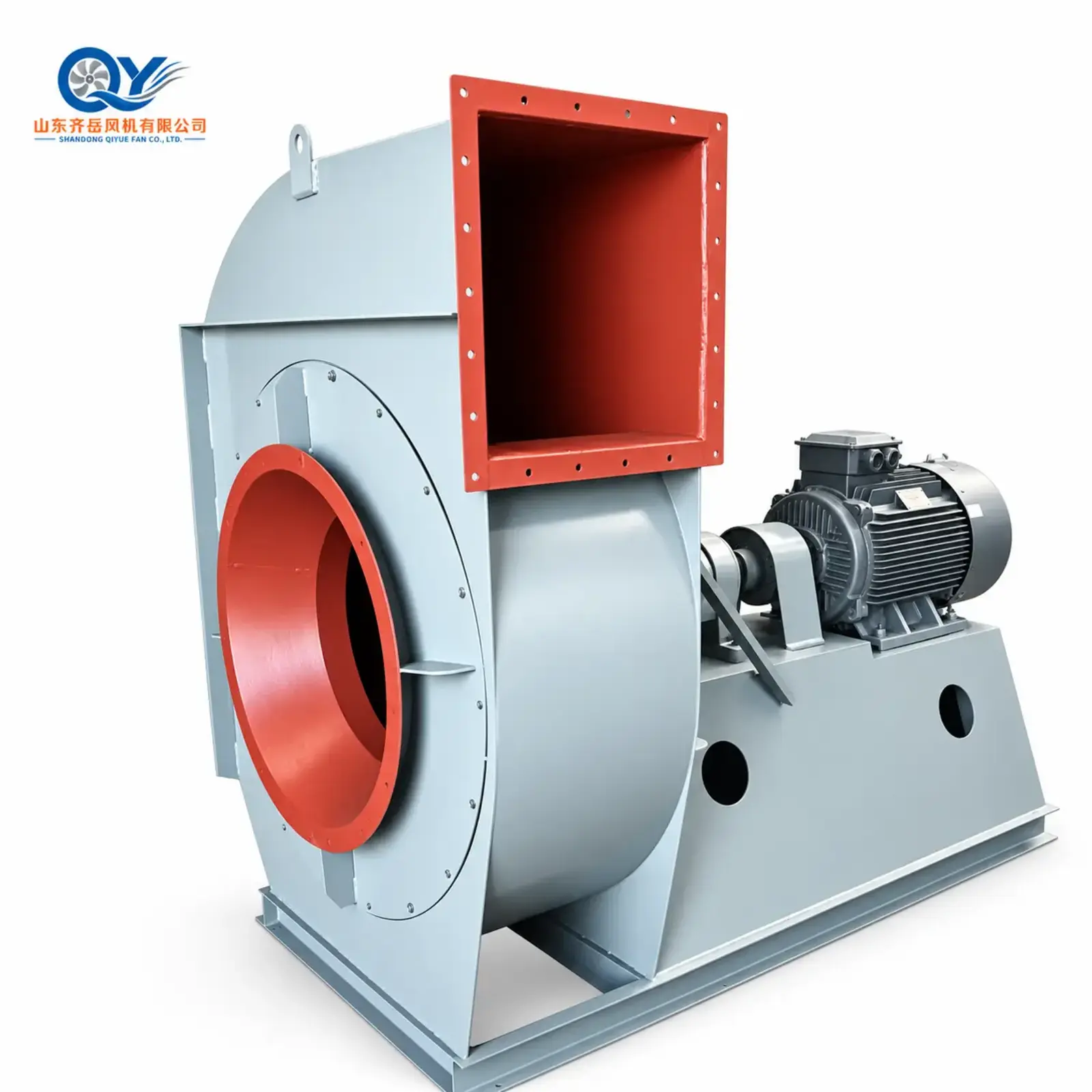
G4-68 is a centrifugal forced draft fan developed for boiler ventilation and combustion-air supply. The series is commonly applied to steam boiler forced-draft systems and can also be used for other industrial clean-air ventilation duties when the required operating point falls within its range.
Unlike the Y4-68 induced draft series, G4-68 handles clean air rather than boiler flue gas. Standard reference service is based on air with a temperature not exceeding 80°C, so gas temperature and medium condition should still be confirmed before final selection.
G4-68 = Forced Draft
Use G4-68 when the fan is supplying combustion air or process air. Boiler flue-gas extraction belongs to the Y4-68 induced draft series.
02 / Construction
Industrial D-Type Centrifugal Fan Construction
01
Impeller
12 backward-inclined airfoil blades designed for stable centrifugal airflow.
02
Volute Casing
Welded steel spiral casing for conversion of impeller velocity into pressure.
03
Inlet
Streamlined converging inlet mounted on the casing inlet side.
04
Inlet Damper
Adjustable inlet device for airflow regulation when required by the system.
05
D-Type Drive
Fan shaft and motor connected through an elastic coupling.
04 / Rotation & Arrangement
Confirm Rotation and Outlet Angle Before Ordering
Rotation
Left-hand or right-hand rotation, viewed from the motor side.
Outlet Angles
0° / 45° / 90° / 135° / 180° / 225°
Drive
D-type arrangement with elastic coupling.
Inlet Control
Inlet damper arrangement can be used for airflow adjustment.
05 / Application Fit
Typical G4-68 Forced Draft Applications
Boiler Combustion Air
Forced-air supply to boiler combustion systems.
Application →
Industrial Furnace Air
Process-air and combustion-air supply for furnace systems.
Process Air Supply
Medium-pressure clean-air supply for industrial process systems.
General Ventilation
Clean-air industrial ventilation where the operating point matches the G4-68 range.
06 / Before Selection
Information Required for G4-68 Selection
01
Airflow
Required combustion-air or process-air volume.
02
Pressure
Required static or total pressure.
03
Air Temperature
Normal and maximum inlet-air temperature.
04
Rotation
Left-hand or right-hand rotation.
05
Outlet Angle
Required discharge direction and duct arrangement.
06
Electrical
Voltage, frequency, phase and motor requirements.
07 / Replacement Projects
Replacing an Existing Boiler Forced Draft Fan?
Send the existing fan model, nameplate, inlet and outlet dimensions, rotation, outlet angle, motor information, installation photos and available operating data. These can be used as the starting point for engineering comparison.
08 / Technical References
Related Engineering Guides
Product Path
Continue Through the Boiler Fan Range
Boiler & High-Temperature Fans
Browse boiler forced draft, induced draft and high-temperature fan products.
View Product Range →
Industrial Forced Draft Fan System
Understand system-level forced-draft fan selection.
View Application →
09 / FAQ
G4-68 Forced Draft Fan Questions
What is the G4-68 fan used for?
G4-68 is primarily used for boiler forced-draft and combustion-air supply, as well as suitable clean-air industrial ventilation duties.
Is G4-68 a forced draft or induced draft fan?
G4-68 is the forced-draft / ventilation version. Y4-68 is the corresponding induced-draft series for boiler flue-gas handling.
What is the G4-68 airflow range?
Published reference performance covers approximately 16,011 to 161,499 m³/h depending on fan size and speed.
What air temperature can G4-68 handle?
Standard reference service is for clean air at temperatures not exceeding 80°C. Higher-temperature conditions should be reviewed separately.
Can rotation and outlet direction be specified?
Yes. G4-68 can be configured for left or right rotation with 0°, 45°, 90°, 135°, 180° or 225° outlet positions.
Can the motor be supplied for different voltages and frequencies?
Motor selection can be reviewed according to required voltage, frequency, phase and destination-market project requirements.