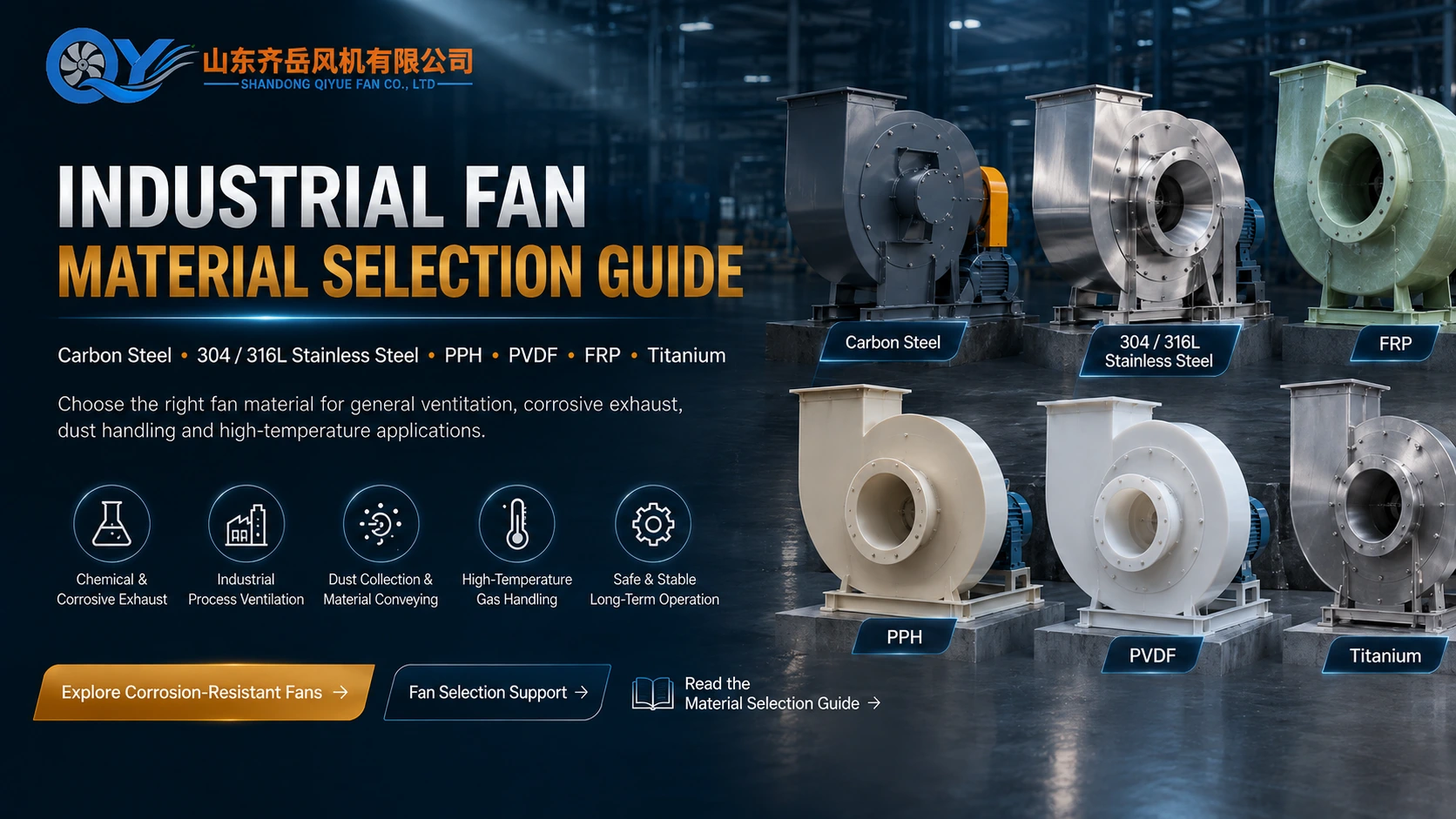
Industrial Fan Material Selection Guide: Carbon Steel, Stainless Steel, FRP And Plastic Fans
The fan model determines airflow and pressure, while the material determines whether the fan can withstand the actual medium and operating duty. This guide compares carbon steel, 304 and 316L stainless steel, PPH, PVDF, FRP and titanium, and explains how corrosion, temperature, moisture, particles, fan position and mechanical loading should be reviewed together.
Air Medium
Clean air, humid air, corrosive gas, dust-laden air, flue gas or mixed industrial exhaust.
Corrosion Level
Normal, humid, weak corrosive, acid gas, alkaline gas or chemical exhaust condition.
Temperature
Normal temperature, high-temperature flue gas, kiln exhaust, drying air or furnace exhaust.
Dust Condition
Dust concentration, particle size, hardness, abrasiveness, stickiness and pre-separation requirement.
Fan Position & Mechanical Duty
Before or after treatment equipment, pressure class, impeller speed, duct loads, drainage, sealing and maintenance access.
Why Industrial Fan Material Selection Matters
A fan used for normal factory air may not be suitable for acid gas, hot flue gas or abrasive dust. If the material is not matched with the medium, the casing may corrode, the impeller may wear quickly, the coating may fail, or the bearing and motor arrangement may become unsuitable for the site condition.
Before quotation, QIYUE FAN reviews the working condition together with airflow and pressure. The material decision should consider gas composition, concentration, humidity, condensate, continuous and peak temperature, particles, fan position, speed, structural loading and maintenance access. For corrosive systems, compare the six product directions in the Corrosion-Resistant Fans hub and review the complete Chemical Plant Corrosive Gas Exhaust System.
Material Comparison for Industrial Fan Selection
The following matrix is a preliminary screening tool. Final material compatibility must follow the exact gas composition, concentration, moisture, temperature, particles, fan position, mechanical duty and required air-contact scope.
| Fan Material | Typical Starting Point | Critical Review Focus | Related Page |
|---|---|---|---|
| Carbon Steel | Clean or non-corrosive air, general ventilation and many standard industrial duties. | Coating condition, outdoor exposure, temperature, dust wear and maintenance cycle. | Centrifugal Fans → |
| 304 Stainless Steel | Humid air, cleaner process exhaust and mildly corrosive ventilation. | Chlorides, cleaning chemicals, condensate and gas-contact scope. | View 304 Fan → |
| 316L Stainless Steel | Wet process exhaust, scrubber systems and selected chloride-risk duty. | Condensate chemistry, chloride concentration, crevices, droplets and fabrication. | View 316L Fan → |
| PPH Polypropylene | Selected acid mist, alkaline vapor, laboratory and wastewater exhaust. | Solvents, oxidizers, temperature, static risk, pressure and plastic stiffness. | View PPH Fan → |
| PVDF Fluoropolymer | Selected severe chemical, oxidizing or high-purity process exhaust. | Strong alkalis, exact resin grade, purity, temperature, welding and structure. | View PVDF Fan → |
| FRP Composite | Chemical exhaust, acid mist, humid gas and larger composite fan duties. | Resin system, temperature, abrasion, UV, pressure and fabrication quality. | View FRP Fan → |
| Titanium / Titanium Alloy | Selected wet chlorine, seawater-related and special severe corrosion. | Moisture, reducing acids, grade selection, crevices, galling and fabrication. | View Titanium Fan → |
| Heat- / Wear-Resistant Direction | Hot gas, boiler flue gas, kiln exhaust and abrasive dust. | Metal grade, thickness, impeller wear, speed, bearings, motor position and maintenance access. | High-Temperature Fans → |
Application to Suggested Fan Material
Different fan applications require different material decisions. Use this table as a practical direction before confirming the final fan model, impeller material, casing material and surface treatment.
General Ventilation
Carbon steel fan with standard coating is usually cost-effective for clean, non-corrosive air.
If a finish is specified, use the coating RFQ guide to separate substrate, protective system and color, and to record the covered surfaces and acceptance evidence.
Dust Collection
Carbon steel or wear-resistant review should be selected according to dust concentration, particle size and hardness.
Corrosive Gas Exhaust
304, 316L, PPH, PVDF, FRP or titanium should be screened by exact gas composition, concentration, moisture, temperature and fan position.
Boiler Induced Draft
High-temperature structure, heat-resistant coating and ash wear review may be required for flue gas.
Chemical Plant Exhaust
304, 316L, PPH, PVDF, FRP or titanium can be reviewed under verified chemistry, temperature, pressure and structural limits.
Food or Cleaner Exhaust
Stainless steel or cleaner surface treatment may be required when moisture resistance or surface cleanliness matters.
How Each Fan Material Direction Is Used
The material name is only the starting point. Exact grade, resin system, fabrication, temperature, pressure, speed and gas-contact scope must be confirmed for the project.
Carbon Steel for General Industrial Ventilation
A practical and cost-effective direction for clean or non-corrosive air, general exhaust, workshop ventilation and many standard industrial duties.
304 Stainless Steel for Humid and Mildly Corrosive Air
Often reviewed for humid process air, cleaner exhaust and mildly corrosive ventilation where better surface corrosion resistance is required.
316L Stainless Steel for Wet Process Exhaust
May be reviewed for scrubber systems, wet process exhaust and selected chloride-risk duty after condensate and concentration checks.
PPH for Selected Acid Mist and Alkaline Vapor
A thermoplastic direction for compatible acid mist, alkaline vapor, laboratory exhaust and selected wastewater applications.
PVDF for Selected Severe or High-Purity Chemistry
May be evaluated for selected severe chemical, oxidizing or high-purity process exhaust where exact resin grade and fabrication are critical.
FRP for Compatible Chemical Exhaust
A composite direction for compatible acid mist, humid chemical exhaust and larger fan duties where the selected resin system is suitable.
Titanium for Selected Wet Chlorine and Seawater-Related Duty
A special-metal direction for selected wet chlorine, seawater-related and severe corrosion after grade, moisture and fabrication review.
Heat- and Wear-Resistant Directions
For boilers, kilns, furnaces, drying systems and abrasive dust, review metal grade, thickness, impeller speed, bearings, motor position and replaceable wear areas.
Corrosion, Temperature, Wear and Structural Duty Are Different Problems
A material may resist one chemical but still be unsuitable because of heat, abrasive particles, pressure, speed or mechanical loading.
Corrosion
Chemical composition, concentration, pH, moisture, oxidizers, reducing acids, salts and condensate.
Temperature
Continuous, peak, cleaning and shutdown temperature, thermal cycling and dew-point crossing.
Wear and Deposits
Dust loading, particle hardness, crystals, sticky deposits, droplet erosion and cleaning access.
Structural Duty
Pressure, impeller speed, stiffness, duct loads, vibration, shaft support, drainage and fabrication quality.
Fan Position Changes the Material Duty
Use the gas condition at the fan inlet-not only the process name-to select the material.
Untreated chemical exposure
Review original concentration, process temperature, chemical peaks, solvents, oxidizers, particles, crystals and direct liquid carryover.
Wet treated-gas exposure
Review high humidity, droplet carryover, condensate chemistry, wash-liquid composition, dissolved salts, demister performance and shutdown accumulation.
Common Material Selection Mistakes
304 and 316L are not universally suitable for acids, alkalis, chlorides, solvents or mixed exhaust.
PVDF is not automatically preferable to PPH or FRP. Chemistry, temperature, fabrication and mechanical duty still require review.
Dust, droplets, crystals and sticky deposits can damage material or contribute to imbalance despite chemical compatibility.
Review continuous, peak, cleaning and shutdown conditions, thermal cycling and condensation.
What to Send When Requesting Fan Material Selection
Application/process; airflow and static or total pressure.
Gas composition/concentration; continuous, peak and cleaning temperature.
Humidity, droplets, dew point and condensate; dust, crystals, stickiness and abrasion.
Fan location before or after treatment; speed, structure, layout, motor and quantity.
FAQ About Industrial Fan Material Selection
Is stainless steel always better than carbon steel?
No. Carbon steel remains practical for clean, non-corrosive air. Stainless steel should be selected only when moisture, cleanliness or verified corrosion conditions justify it.
What is the difference between 304 and 316L fan material?
316L may provide a better starting direction for selected wet or chloride-risk duty, but exact chloride concentration, condensate chemistry, temperature, crevices and fabrication must still be reviewed.
What is the difference between PPH and PVDF fans?
PPH is commonly reviewed for compatible acid mist, alkaline vapor and conventional chemical exhaust. PVDF may be evaluated for selected more severe or high-purity chemistry. Neither is universally suitable.
When should an FRP corrosion-resistant fan be considered?
FRP may be considered for compatible acid mist, humid chemical exhaust and composite fan duties. Resin system, concentration, temperature, pressure, abrasion and fabrication quality must be confirmed.
When should titanium be reviewed?
Titanium may be reviewed for selected wet chlorine, seawater-related and severe special corrosion. Moisture, reducing acids, exact grade, crevices and fabrication remain critical.
Can the same fan model be made from different materials?
Sometimes, but not every model, size, speed or pressure class is available in every material. Fan platform, structural duty and fabrication capability must be confirmed together.
Why does fan position before or after a scrubber matter?
A fan before the scrubber may face untreated concentration, temperature and particles. A fan after the scrubber may face high humidity, droplets, condensate, dissolved salts and wash-liquid chemistry.
What material should be used for hot or abrasive gas?
Corrosion resistance alone is not enough. Review heat-resistant grade, thickness, impeller speed, wear areas, bearings, motor position, deposits and maintenance access.
Continue from Material Screening to Product and System Selection
Need Help Confirming the Right Fan Material?
Send your working conditions to QIYUE FAN. Our team will review application, gas composition, concentration, moisture, temperature, particles, airflow, pressure, fan position and mechanical duty before suggesting a material direction and fan configuration.
Send Inquiry
Send Your Operating Conditions
Airflow, pressure, gas medium, temperature, voltage and quantity.