
Industrial Fan Technical Documentation Package: From RFQ To Final Handover
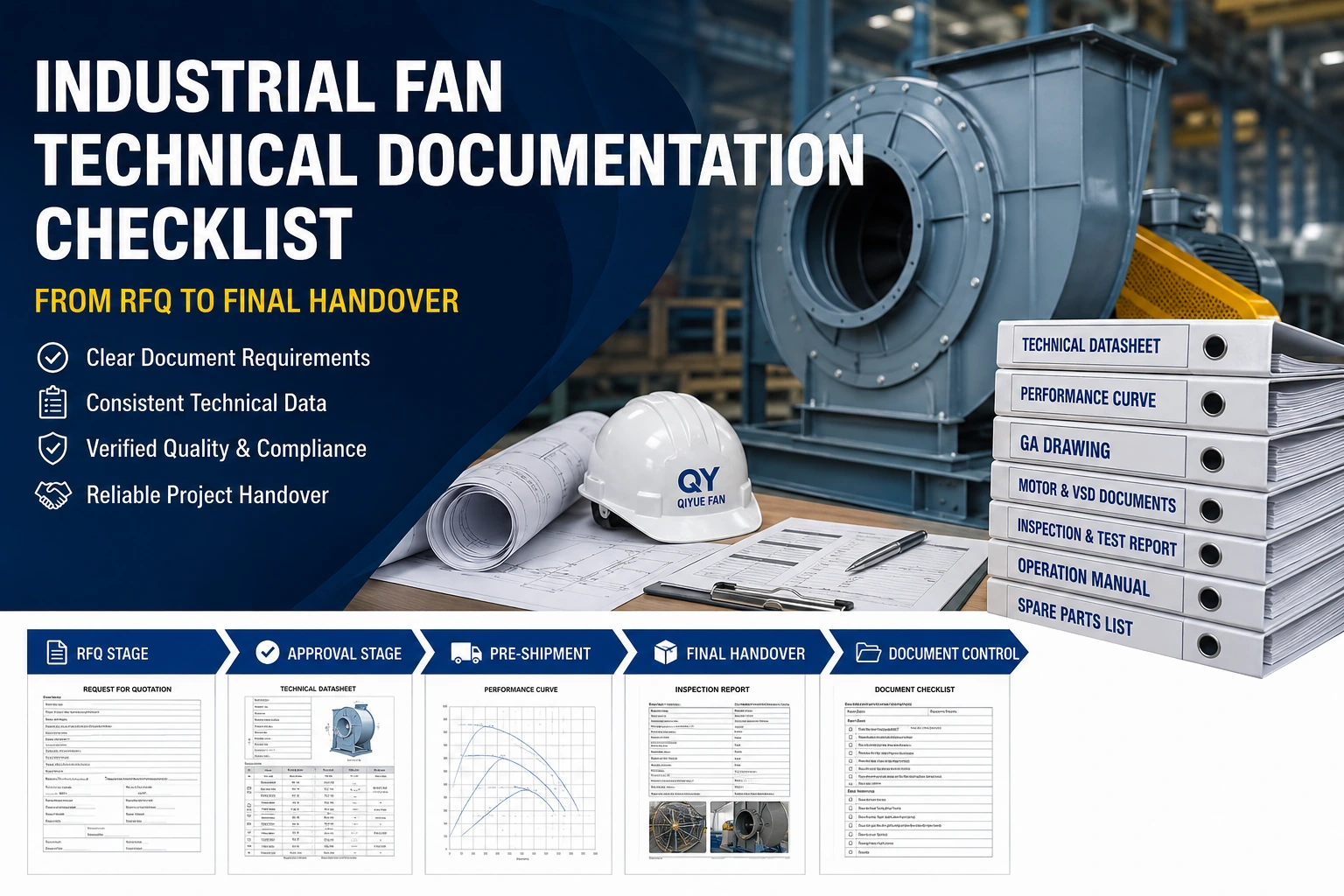
Industrial fan projects require more than a quotation, performance curve and general arrangement drawing. Buyers need a controlled technical documentation package that records what was requested, selected, approved, manufactured, inspected and finally delivered.
This is especially important when the end user, engineering contractor, procurement company, equipment integrator, fan manufacturer, motor supplier and inspection agency are all involved in the same project.
The purpose of document control is not simply to collect more files. It is to maintain a traceable connection between the original operating requirement, the approved technical solution, the manufactured fan and the equipment finally handed over to the customer.
For available fan families and model directions, review the QIYUE industrial fan product range. Product selection and documentation scope should be confirmed together for the actual operating conditions and destination market.
Technical-Only Submittal Pack for End-User Review
Some projects require a technical package that can be forwarded to an end user without the supplier’s commercial offer. Prepare separate technical and commercial issue sets rather than sending the full quotation and expecting the recipient to remove confidential pages.
One controlled equipment reference. Two issue sets.
Confirm the recipients and revision of each set. Do not send commercial details in a technical-only issue.
Define the technical issue set
Confirm the requested review scope before assembling the files. A technical-only set may include the selected equipment datasheet, performance basis, general arrangement drawing with overall and connection dimensions, and applicable conformity documentation. Include only the documents required for that review and identify their status and revision.
- Technical pack: equipment identification, agreed technical scope, drawings and supporting records required by the reviewer.
- Commercial pack: prices, discounts, payment terms and delivery terms, kept with the authorized purchasing recipients.
- Shared reference: a controlled equipment tag or technical reference that connects both packs without exposing commercial content.
Removing commercial information must not remove the equipment identity, drawing revision, technical assumptions or limitations needed to understand the proposal. Keep original issued conformity documents intact; if a document cannot be shared appropriately, resolve that with the responsible document owner rather than editing its scope or making an unofficial replacement.
Check the outgoing files, not only the email text
Review filenames, cover sheets, drawing notes, embedded attachments and visible document content for unintended commercial information. Confirm the intended recipients and the approved issue set. Retain a record of the files and revisions sent so that later comments refer to the same technical proposal.
A sketch issued for dimensional review is not automatically a manufacturing-approved drawing. Mark the purpose of issue, record the review comments and identify the person responsible for closing them. Technical review and commercial acceptance should remain separately traceable.
The RFQ defines what the manufacturer is expected to select and what evidence should be included in the offer.
The technical offer should show how the RFQ was interpreted and provide enough detail for technical comparison.
Preliminary documents should be converted into controlled project documents before production.
The final package should represent the fan that was actually manufactured and shipped.
A preliminary document should not be treated as a final manufacturing record. Every approval-stage document should carry a clear status and revision number.
Example Document-Stage Checklist
This is a planning template, not a statement that every listed deliverable is included in every order. Agree the document list, issue stages and acceptance requirements for the specific project.
| Document | RFQ | Approval Stage | Pre-Shipment | Final Handover |
|---|---|---|---|---|
| Technical Datasheet | Preliminary | Approved | Final check | Final |
| Performance Curve | Preliminary | Approved | Final | Final |
| GA Drawing | Preliminary | Approved | As-built check | As-built |
| Motor / VSD Datasheet | Preliminary | Approved | Supplied-unit check | Final |
| Nameplate Data | Proposed | Approved | Photograph | Final record |
| Inspection / Balancing Records | Required list | Method agreed | Executed | Included |
| Compliance / Conformity Documents | Required scope | Applicability confirmed | Final copy check | Included when applicable |
| O&M Manual / Spare Parts | Required list | Draft or outline | Draft | Final |
Model Traceability Across Quote, Drawing, Nameplate and Declaration
A buyer’s item code, project equipment tag and manufacturer’s model designation can refer to the same proposed fan while serving different purposes. Make that relationship explicit in a cross-reference record; do not silently replace one identifier with another across the document set.
Cross-check the identity, then verify document applicability.
Equipment tag
Configuration reference
Nameplate · Applicable declaration
A matching label does not extend the scope of any certificate or declaration.
Use one cross-reference record per equipment item
- Purchasing reference: quotation revision and line item, retained in the appropriate issue set.
- Project identity: buyer item code and equipment tag used in the technical submission.
- Manufacturing identity: manufacturer name and exact proposed model, size and configuration reference.
- Engineering records: datasheet and drawing numbers, revisions and issue status.
- Physical identification: approved nameplate reference and, when available, the supplied unit’s serial number.
- Conformity reference: the applicable document identifier, covered manufacturer and model scope, review status and unresolved questions.
Use this record to check that a quotation revision, drawing and proposed nameplate still describe the same equipment. When a model or configuration changes, identify the affected records and request updated review rather than changing the cross-reference alone. Keep earlier revisions distinguishable from the current proposal.
A naming cross-reference does not expand conformity scope
Mapping a customer code to a manufacturer’s model does not change the models, manufacturer, product configuration or other conditions covered by a declaration or certificate. A renamed item is not automatically covered. Check the actual issued document and its applicable annexes against the offered equipment, and obtain clarification from the responsible compliance party where the relationship is uncertain.
Do not edit an issued declaration to insert a customer code or imply broader coverage. Keep any explanatory cross-reference separate and clearly identified. Until applicability is confirmed, record the question as open rather than offering a conformity guarantee.
Before final handover, reconcile the approved technical records with the supplied equipment identification. The purpose is a traceable chain from the reviewed proposal to the actual fan, not merely matching text labels across files.
The nameplate should be reviewed before production and photographed before shipment.
For relevant EAEU projects, the final technical package may also include product-compliance documentation when the selected fan model falls within the registered declaration scope.
Shandong Qiyue Fan Co., Ltd. holds an EAEU Declaration of Conformity, registration number ЕАЭС N RU Д-CN.РА07.В.29078/26, for listed industrial fan models under TR CU 010/2011 and TR CU 020/2011. The declaration is registered for serial production and is valid from August 19, 2026 through August 18, 2031.
When an Input Changes, Check the Affected Documents
A newer quotation does not automatically make an older drawing or selection curve current. Use this review aid to identify records that may need checking; the responsible engineering and purchasing parties decide what must be revised and approved.
01 / Duty or gas condition
Examples: revised flow, pressure basis, temperature, gas composition or operating case.
Ask which selection datasheet, curve, speed, motor or construction assumptions require review. Do not assume that the earlier selection remains valid.
02 / Installation interface
Examples: changed outlet direction, mating flange, foundation or available space.
Cross-check the GA revision, connection drawings and any agreed adapters or supports. Identify who must approve the site-side interface.
03 / Supply or inspection scope
Examples: a motor, accessory, document or witness inspection is added or removed.
Reconcile the quotation line, scope register, document list and relevant review milestone. Request confirmation of any price or lead-time effect instead of assuming it.
Record the change, not just the latest filename
Change reference: equipment tag, request date and request owner.
Before / after: old requirement and proposed replacement.
Affected records: document number, current revision and review owner.
Disposition: revised / reviewed with no revision needed / still open, with the supporting response.
Release: approval reference and authorized issue status, where required.
Keep earlier revisions distinguishable from the current issue set. Do not mark an open change as approved merely because a new PDF has arrived. Before handover, reconcile the agreed change with the equipment identification and final records.
For related review stages, see quotation and scope comparison and the pre-shipment evidence checklist.
Illustrative Technical Deviation Register
Read the entries below only as examples of how to record a deviation and its review status, not as evidence of a customer project, a QIYUE offer, or standard motor, material, VSD or testing scope. Replace them with the actual requirement, offered configuration, explanation and documented decision for each equipment item.
| Buyer Requirement | Manufacturer Offer | Status | Technical Explanation | Approval |
|---|---|---|---|---|
| 400 V / 50 Hz motor | 380 V / 50 Hz | Deviates | Standard motor voltage proposed | Pending |
| Integrated VSD | External VSD | Deviates | External cabinet required | Pending |
| 316L gas-contact parts | 304 stainless steel | Deviates | Alternative material proposed | Rejected |
| Witness performance test | Routine factory inspection | Deviates | Test facility not included | Pending |
Send Your Operating Conditions
Airflow, pressure, gas medium, temperature, voltage and quantity.