
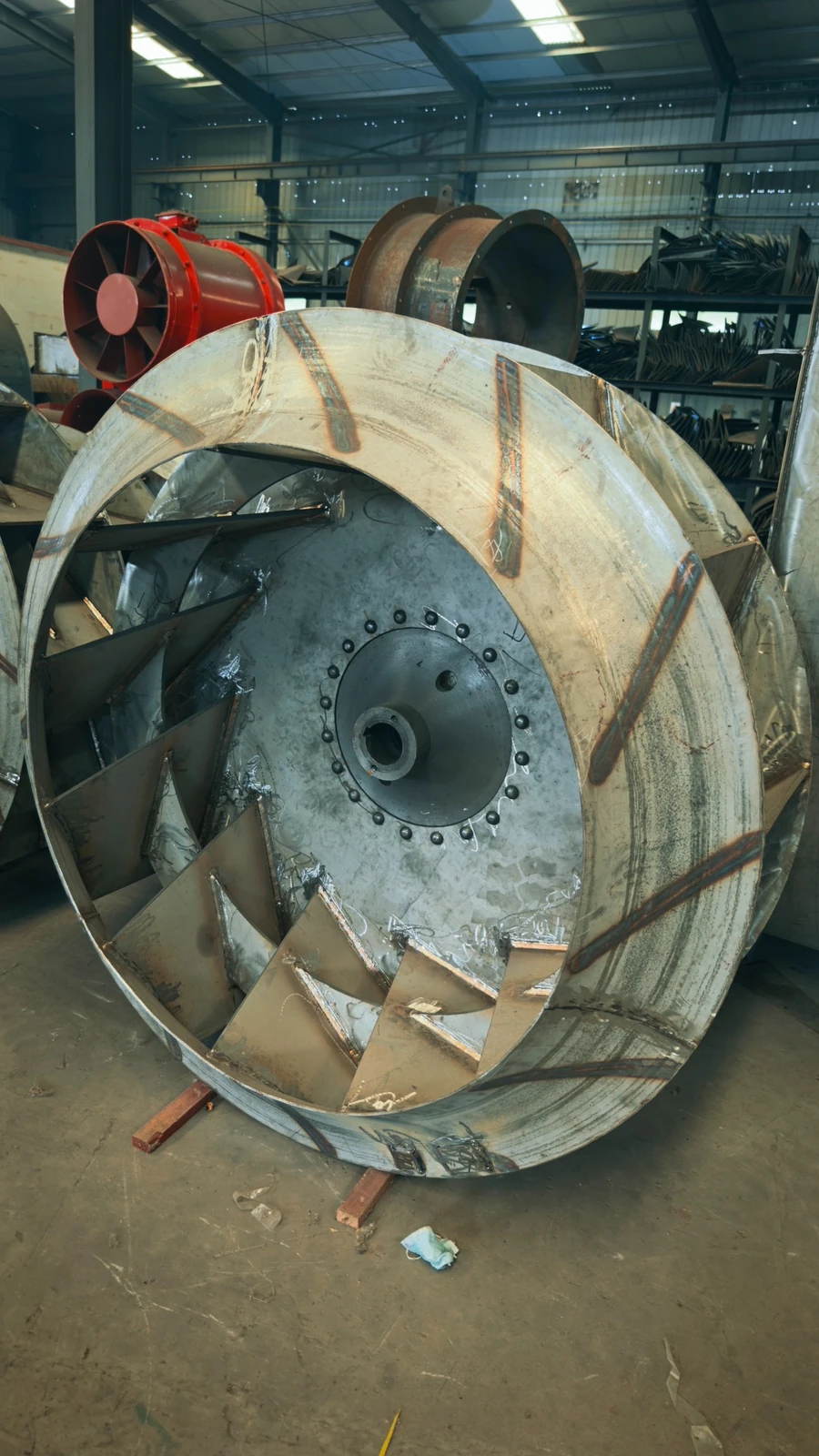
Blade geometry changes the pressure-flow curve, absorbed-power behavior, efficiency range and suitability for clean air, dust, fibers or material-handling duties. Final fan selection must still be confirmed at the required operating point on the tested performance curve.
Start with the Airflow Principle
Blade type is an early selection decision, not a cosmetic difference. If you are first reviewing centrifugal fan structure, airflow direction and basic components, start with What Is a Centrifugal Fan? before comparing impeller blade geometries.
The blade outlet angle is one of the main geometric variables. It influences pressure development, power behavior, efficiency and the way the wheel handles contamination.
Three Wheel Geometries, Three Different Behaviors
The practical difference is not the shape itself. The important question is how each geometry behaves at the required operating point and with the actual working medium.
Forward-Curved
Blade tips curve in the direction of rotation. These wheels commonly use many shallow blades and can provide useful airflow at relatively low rotational speed.
Radial
Fully radial blades extend in the radial direction. They may be open, have a back plate only, or have both a back plate and shroud. Radial-tipped blades are a separate geometry, with a radial portion near the outer edge. Do not equate the word “radial” with an open wheel or automatic suitability for every particle duty.
Backward-Curved
The blade outlet direction leans away from rotation. Within the backward-inclined family, single-thickness flat (BI), single-thickness curved (BC) and airfoil-profile (AF) blades are distinct forms, not interchangeable purchasing descriptions.
One Backward-Inclined Family, Three Different Profiles
Single-thickness, flat blade. Confirm the selected wheel drawing instead of treating BI as a synonym for every backward-facing profile.
Single-thickness, curved blade. Curvature describes the blade form; it does not specify the steel grade or allowable operating speed.
Airfoil contour. A high clean-air efficiency is not proof of suitability for an erosive or corrosive process stream.
These are terminology cards, not scale profiles or a list of guaranteed QIYUE stock configurations. ASHRAE Chapter 21, Table 1 distinguishes these forms and notes single-thickness alternatives where erosion or corrosion makes an airfoil unsuitable. No ASHRAE illustration is reproduced.
Practical comparison: if two offers both say “backward-curved,” ask whether they mean the same blade profile and the same handled medium. Compare their verified curves and construction, not a family label alone. For replacement, the approved wheel drawing and compatible assembly remain decisive.
Compare the Tendencies Before Final Curve Selection
Use the table as an early screening tool only. The manufacturer’s tested duty-point curve remains the final confirmation.
Swipe the table horizontally to see all columns →
| Factor | Forward-Curved | Radial | Backward-Curved |
|---|---|---|---|
| Outlet direction relative to rotation | Toward rotation | Radial | Away from rotation |
| Typical efficiency | Low to moderate | Moderate | Moderate to high |
| Dust tolerance | Generally clean air | Good for selected dust duties | Depends on profile and dust condition |
| Power behavior | Can rise strongly with airflow | Review the full operating range | Often selected for non-overloading tendency |
| Typical use | Compact clean-air equipment | Dust exhaust and material handling | Industrial ventilation and process air |
Choose by Medium and Operating Priority
Start from the gas and particle condition, then review efficiency, pressure requirement, maintenance and operating range.
Efficiency and Stable Operation
Review backward-curved or backward-inclined designs for industrial ventilation, process air, cooling, drying and continuous-duty systems.
Particle Condition Comes First
Review dust type, particle size, hardness, concentration, moisture, collector resistance and whether the fan is located on the dirty side or clean side.
Four Common Mistakes to Avoid
- Choosing a blade form from appearance without the required duty point and fan curve.
- Applying a general efficiency ranking to every operating point or medium.
- Ignoring dust, fibers, abrasion, moisture or buildup in the handled air.
- Checking pressure but overlooking absorbed power and the motor margin across the operating range.
Information Buyers Should Provide
A blade type should be recommended from real operating conditions, not from appearance or a copied model number.
- Required airflow
- Static or total pressure
- Gas temperature and composition
- Dust concentration and particle size
- Particle hardness, moisture and stickiness
- Duct and equipment resistance
- Fan position in the process
- Inlet and outlet direction
- Voltage and frequency
- Operating hours and control method
Continue Your Centrifugal Fan Selection
Use the fan curve guide to compare the duty point and absorbed power, then review material selection and submit the operating condition through the fan selection center.
Replacing an existing wheel rather than selecting a blade type? Review the impeller replacement purchasing checklist for component interfaces, rotation, speed and acceptance scope.
FAQ About Centrifugal Fan Blade Types
Which centrifugal fan blade type is most efficient?
Backward-inclined designs can offer high efficiency, but the result depends on profile and duty point. Review airfoil erosion and corrosion exposure before specifying it for contaminated air; do not extend a clean-air efficiency comparison to every process gas.
Which blade type is better for dust?
Radial or specially designed open impellers are often reviewed for dust, fibers and particles. Concentration, hardness, moisture and particle size remain decisive.
Why can a forward-curved fan overload its motor?
Absorbed power can rise as airflow increases. Lower system resistance may move the operating point into a higher-flow, higher-power region.
Is blade type enough to select a centrifugal fan?
No. Airflow, pressure, RPM, wheel diameter, casing, medium, temperature, material, drive arrangement and motor power must be checked together.
Need Help Choosing a Centrifugal Fan Impeller?
Send the duty point and working medium. QIYUE FAN can review blade direction, fan series, material, speed, drive arrangement and motor configuration before final selection.
Send Your Operating Conditions
Airflow, pressure, gas medium, temperature, voltage and quantity.