
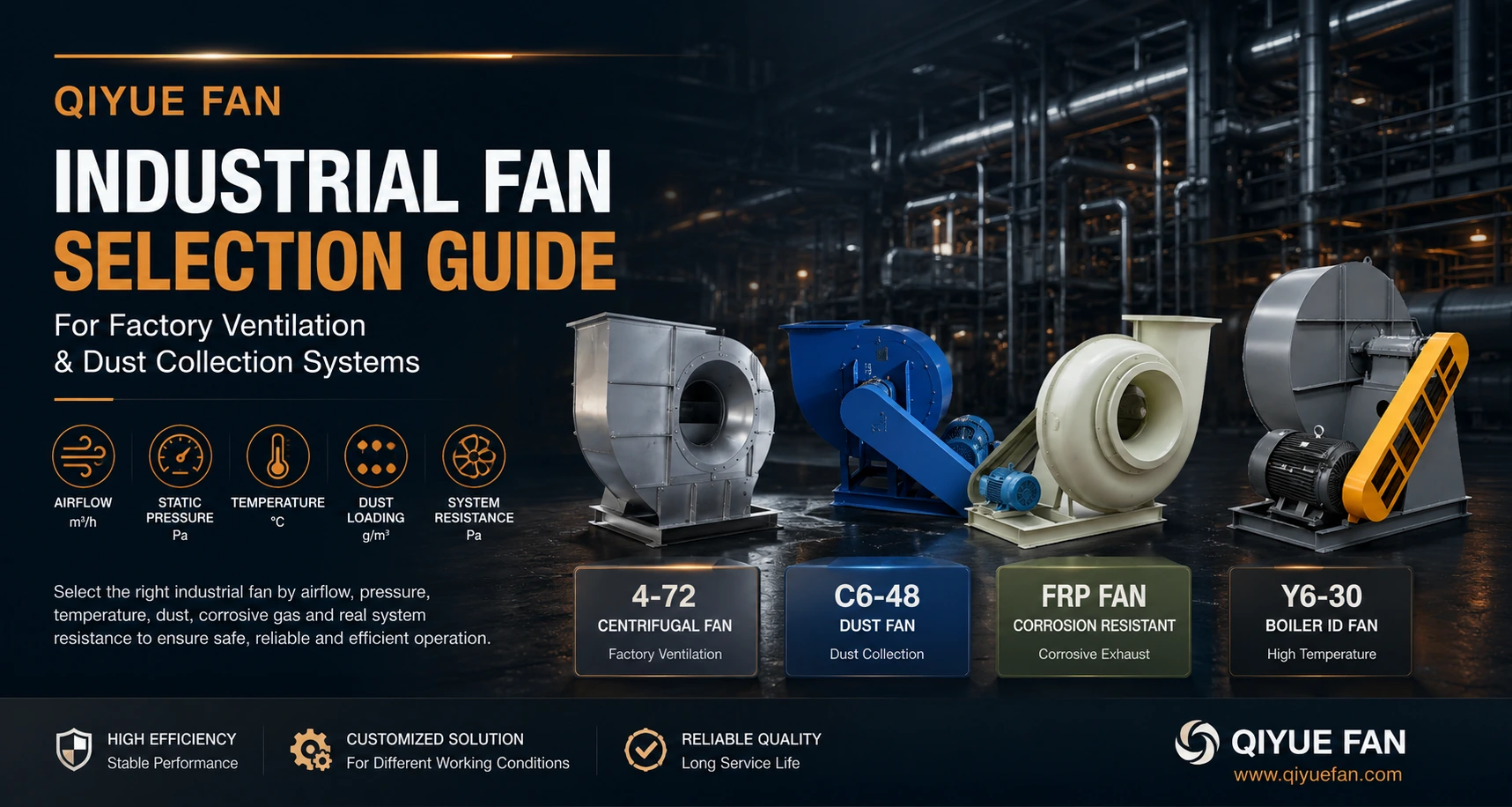
Industrial Fan Selection Guide For Factory Ventilation And Dust Collection
Industrial Fan Selection Guide
Selecting an industrial fan is not only about choosing a model number. The right fan should match airflow, static pressure, temperature, dust condition, corrosive gas, duct resistance, installation layout and motor configuration.
Use this guide to compare centrifugal fans, axial flow fans, dust collection fans, boiler and high-temperature fans, mine and tunnel ventilation fans, corrosion-resistant fans and explosion-proof fan directions before sending working conditions to QIYUE FAN.
Required air volume in m³/h or CFM. Airflow must match the process demand and active capture points.
Confirm static pressure, total pressure or system resistance from ducts, filters, collectors, dampers and outlets.
Clean air, dust, smoke, heat, moisture, corrosive gas or a hazardous atmosphere can affect fan type, material and safety configuration.
Outlet direction, rotation, motor position, foundation, power supply and maintenance access must fit the site.
7 Steps Before Choosing an Industrial Fan
A practical industrial fan selection should start from the system, not from the fan model. The same fan can perform very differently after it is connected to ducts, filters, dust collectors, dampers or high-temperature exhaust lines.
Check required air volume in m³/h, CFM or by room air change rate.
Confirm static pressure, total pressure or the complete system resistance from ducts, filters, collectors, dampers and outlets.
Separate normal air, continuous hot air and peak-temperature exhaust.
Dust, moisture, sticky material, smoke, corrosive gas and hazardous-area conditions affect structure, material and configuration.
Compare centrifugal, axial, dust collection, boiler/high-temperature, mine/tunnel, corrosion-resistant and explosion-proof fan directions.
Carbon steel, 304/316L stainless steel, FRP, PPH, PVDF, titanium or wear-resistant design may be required according to the medium and duty.
Send airflow, pressure, medium, temperature, layout and quantity for review.
Match Working Condition to Fan Type
Different industrial applications require different fan structures. This table gives a practical first direction before detailed model selection.
| Working Condition | Recommended Fan Type | Main Selection Focus | Related QIYUE FAN Page |
|---|---|---|---|
| General factory ventilation | Centrifugal fan or axial flow fan | Airflow, room size and installation position | Workshop Ventilation |
| Dust collection | Dust collection centrifugal fan | Dust type, filter resistance, particle size and impeller wear | Dust Collection System |
| Baghouse dust collector | Baghouse fan / dust collector fan | Filter resistance, loaded-filter pressure drop and static pressure | Baghouse Fan Selection |
| Boiler induced draft | Boiler induced draft fan | Flue gas volume, dust collector resistance and temperature | Boiler Induced Draft System |
| Tunnel construction ventilation | Axial fan, local fan or jet fan | Duct length, leakage, pressure loss and working face distance | Tunnel Ventilation |
| Corrosive gas exhaust | FRP or corrosion-resistant fan | Gas composition, concentration, humidity and temperature | Chemical Plant Exhaust |
| Hazardous or flammable-gas ventilation | Explosion-proof fan configuration after project review | Area classification, gas/dust group, temperature class, required Ex marking, airflow and pressure | Explosion Proof Fans |
| High temperature exhaust | High-temperature centrifugal fan | Continuous temperature, peak temperature and motor position | High Temperature Exhaust |
Centrifugal Fan, Axial Fan, Boiler Fan or Special-Condition Fan?
Centrifugal Fans
Suitable for duct systems, dust collectors, filters, high resistance exhaust and industrial air delivery.
Axial Flow Fans
Suitable for large airflow and relatively low-pressure ventilation such as wall, roof or tunnel airflow.
Boiler Draft Fans
Used for forced draft or induced draft in boiler systems, flue gas lines and dust collector exhaust routes.
Dust Collection Fans
Used with dust collectors, baghouses, hoods and ducts where dust type and abrasion must be checked.
Mine & Tunnel Fans
Used for underground mine ventilation, tunnel construction ventilation and auxiliary local airflow.
Corrosion-Resistant Fans
Used for acid mist, chemical gas, humid corrosive air and exhaust systems requiring FRP or special material.
Explosion-Proof Fans
For hazardous-area ventilation after the area classification, medium, required Ex marking, airflow, pressure, material and electrical configuration are confirmed.
Parameters QIYUE FAN Needs Before Recommendation
The more complete the working-condition information is, the more accurate the fan selection can be. A model name alone is not enough for stable on-site airflow.
| Parameter | What to Confirm | Why It Matters |
|---|---|---|
| Airflow | m³/h, CFM or air change requirement | Determines how much air must move through the system. |
| Pressure Basis | Static pressure, total pressure or complete system resistance | Confirms the pressure value that must be matched with airflow at the operating point. |
| Temperature | Normal, continuous high temperature and peak temperature | Affects casing, bearing, motor position and material selection. |
| Dust Condition | Dust type, concentration, particle size and hardness | Affects impeller wear, collector position and maintenance access. |
| Corrosive Gas | Gas composition, concentration, humidity and temperature | Determines whether FRP, stainless steel or coating is required. |
| Installation Layout | Duct route, outlet angle, rotation, motor position and space | Affects final structure, installation and maintenance. |
| Hazardous Area | Zone / division, gas or dust group, temperature class, required Ex marking and destination standard | Determines whether an explosion-proof configuration and project-specific compliance review are required. |
| Power Supply | Voltage, frequency, phase and motor protection requirement | Ensures the motor and control system match local site conditions. |
Start Selection from These QIYUE FAN Pages
Build a Complete Fan Selection Understanding
FAQ About Industrial Fan Selection
How do I choose between a centrifugal fan and an axial flow fan?
Use an axial flow fan for large airflow and low resistance. Use a centrifugal fan when the system has ducts, filters, dust collectors, high pressure or process exhaust resistance.
What information is most important for selecting a dust collection fan?
Airflow, static pressure, dust type, dust concentration, particle size, particle hardness, filter resistance, duct layout and operating temperature are the key factors.
When should I choose an FRP corrosion-resistant fan?
Choose an FRP corrosion-resistant fan when the exhaust contains acid mist, alkali gas, chemical fumes, high humidity or other corrosive components.
Why is static pressure important in industrial fan selection?
Static pressure represents system resistance. If it is underestimated, the fan may not deliver enough airflow after it is connected to ducts, filters, elbows and discharge outlets.
Can QIYUE FAN recommend a model from working conditions?
Yes. Send airflow, static pressure or total pressure, temperature, medium condition, duct layout, outlet direction, voltage and quantity. QIYUE FAN can review the suitable fan type and model direction.
Can one fan model fit every industrial application?
No. Fan type, speed, material, motor power, outlet angle and transmission arrangement should be checked against the real operating point and installation layout.
Need Help Selecting an Industrial Fan?
Send your application, airflow, static pressure or total pressure, temperature, dust or corrosive condition, duct layout, outlet angle, rotation direction, motor standard and quantity. QIYUE FAN will review a suitable centrifugal fan, axial fan or special-condition fan direction for your project.
QIYUE FAN CO., LTD. | Industrial Ventilation Fan Manufacturer | Tel / WeChat / WhatsApp: +86 15653305981 | Email: sales@qiyuefan.com
Send Inquiry
Send Your Operating Conditions
Airflow, pressure, gas medium, temperature, voltage and quantity.