
How To Select An Industrial Fan When Static Pressure Is Unknown
Airflow Is Known.
Static Pressure Is Not.
The missing pressure is not hidden inside the airflow value. It comes from the resistance of the actual duct and process system. Start with the system information you already have, then confirm the pressure basis before final fan selection.

Airflow tells us how much air must move.
Static pressure tells us how much resistance the fan must overcome. Two ventilation systems can require exactly the same airflow while requiring completely different fan pressures.
A short open duct, a dust-collection system and a scrubber exhaust system may all require 32,000 m³/h, but their filters, elbows, duct lengths and process equipment create different resistance.
When static pressure is unknown, the correct next step is system review – not fan-model guessing.
Static Pressure Is a System Requirement, Not an Airflow Value
Required pressure follows the complete system resistance at the intended airflow, including ducts and connected equipment. It cannot be read directly from an airflow figure.
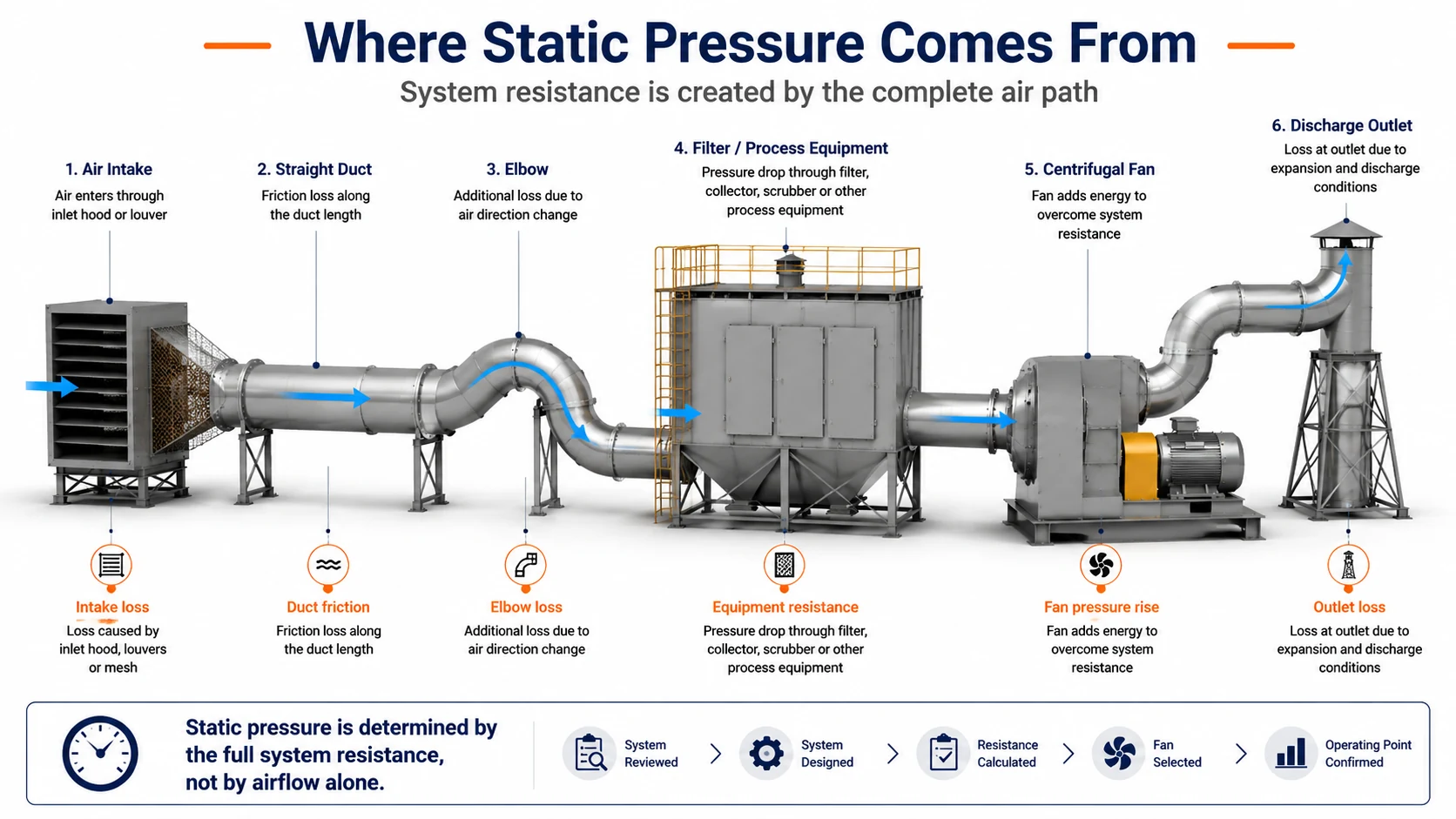
The Selection Logic
When pressure is missing, the selection path matters.
Pressure Unknown Does Not Mean the Review Must Stop
Available system information can identify the major resistance sources and show what still needs to be calculated, measured or confirmed.
These values cannot confirm the fan by themselves
Airflow, motor power or a model name alone does not establish the required system pressure or the actual operating point.
Available system data can establish the next engineering step
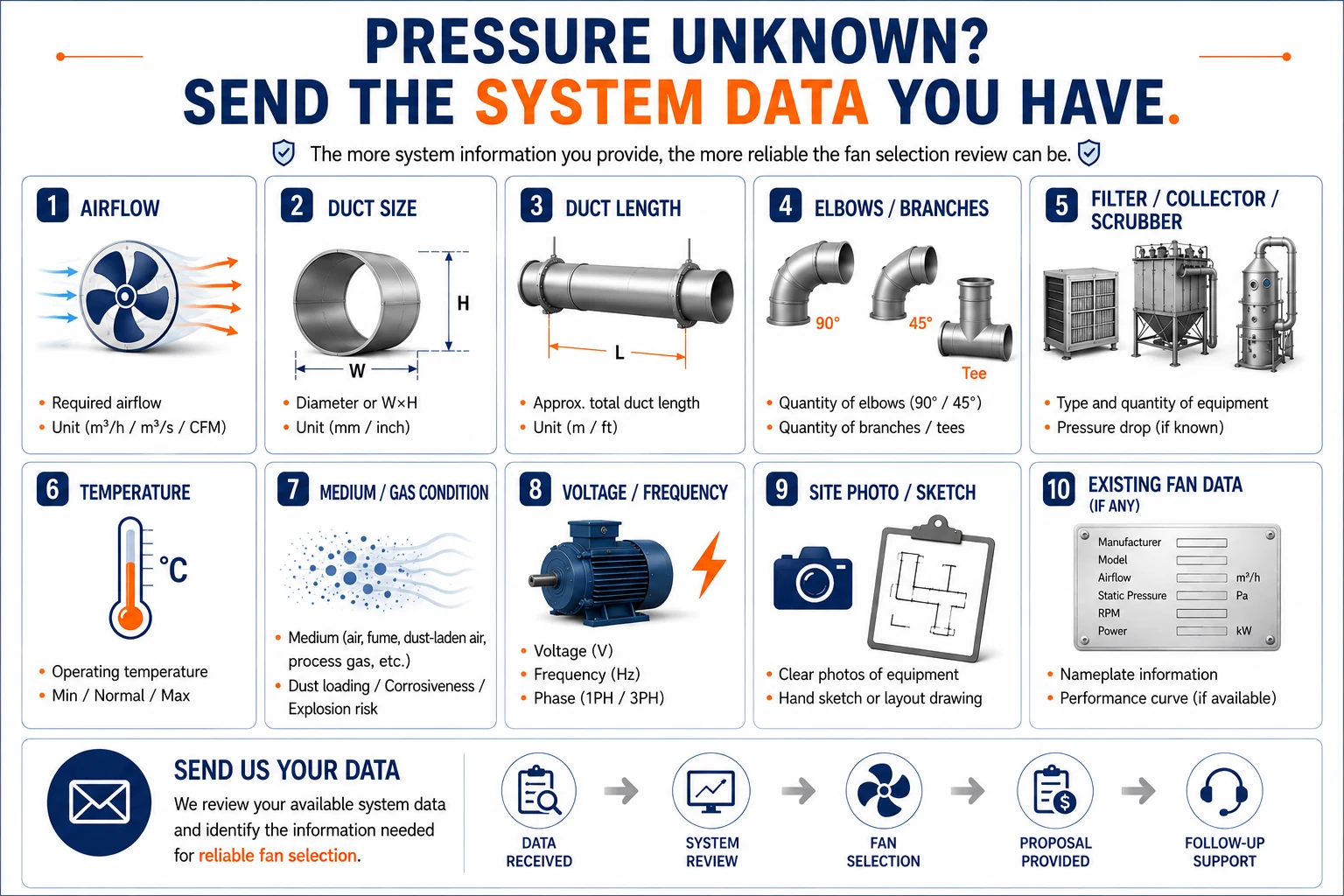
Share duct size and route, bends, filters, hoods, equipment pressure losses, site photos and existing fan records. A qualified system review can then identify what requires calculation or measurement.
Same Airflow. Different System.
The pressure requirement depends on what the air must pass through. This is why airflow alone cannot define the final fan.
Swipe the table horizontally to see all columns →
| Application | Airflow May Already Be Known | Pressure Mainly Depends On | Selection Direction |
|---|---|---|---|
| Workshop Ventilation | Room volume or air-change target | Duct route, louvers, outlet and system layout | Axial or centrifugal fan depending on resistance |
| Dust Collection | Capture hood or process demand | Duct, cyclone, filter and loaded collector resistance | Centrifugal / dust-collection fan |
| Chemical Exhaust | Capture or process ventilation requirement | Duct, scrubber, packed tower and discharge resistance | Corrosion-resistant fan after material review |
| Boiler / Forced Draft | Combustion-air requirement | Burner, damper, air preheater and duct resistance | Forced-draft / higher-pressure centrifugal fan |
| Pneumatic Conveying | Required conveying airflow | Pipeline geometry, material loading and conveying resistance | High-pressure centrifugal fan after system review |
Motor Power Cannot Be Used to Back-Calculate a Reliable Static Pressure
Knowing that a system requires 32,400 m³/h and approximately 8 kW can help define the approximate equipment scale, but it does not uniquely determine pressure. Fan efficiency, speed, operating point, drive arrangement and design margin all affect motor power.
Start the Inquiry Before Every Parameter Is Available
Static pressure may remain marked as “unknown” during the first review, but it must be established before the final operating point and fan model are confirmed.
Pressure Unknown Is Acceptable at the Inquiry Stage
Send the system information already available. We can identify what engineering data must still be confirmed before final fan selection.
Copyable Inquiry Worksheet: Pressure Not Yet Established
The checklist graphic above is available here as text for your email or project brief. Keep missing fields marked unknown; do not enter zero or invent a pressure value just to complete the inquiry.
Application and required airflow (with units):
Airflow source: process requirement / design record / measurement / unknown
Required fan pressure: UNKNOWN — system review requested
Duct cross-section and units:
Approximate duct route and total length (with units):
Elbows, branches, tees and quantity:
Filters / collectors / scrubbers / other connected equipment:
Available equipment pressure-loss data and operating condition:
Gas medium, dust, moisture, corrosion or hazardous-area considerations:
Fan-inlet temperature: minimum / normal / maximum:
Electrical supply: voltage / frequency / phase:
Existing fan: model / nameplate / curve / operating speed (if available):
Attachments: system sketch / site photos / equipment datasheets:
Known process or duct changes:
Items still unknown and person responsible for confirming them:
Label any pressure figure you later supply with its source, airflow, units and static/total basis, and state whether it covers one component or the whole system. A completed inquiry sheet starts the review; it is not final fan-selection approval.
Continue the Technical Review
Use the fan curve guide to understand the operating point, the pressure-definition guide to state the RFQ basis and the GA drawing guide to confirm installation interfaces.
Fan Selection When Static Pressure Is Unknown
Can I select an industrial fan if I only know the airflow?
Not reliably. Airflow defines how much air must move, while pressure defines how much system resistance the fan must overcome. Both are required for the final operating point.
Can static pressure be reviewed from duct information?
Duct size, length, elbows, branches and process equipment can identify the main resistance sources. Final pressure should be based on a system calculation, project design value or reliable measurement.
Can motor power determine the required fan pressure?
No. Motor rating is influenced by airflow, pressure, fan efficiency, speed, drive configuration and design margin.
What should I send if no pressure calculation exists?
Send airflow, duct dimensions, approximate route, elbows, filters or collectors, process equipment, temperature, medium, site photos and any existing fan information.
Can an old fan nameplate help?
Yes. Model, airflow, pressure, RPM, motor power and nameplate information can provide useful reference data, especially for replacement projects.
Know the Airflow but Not the Static Pressure?
Send the information you already have. QIYUE FAN can review the system data and identify what must still be confirmed before final fan selection.
Send Your Operating Conditions
Airflow, pressure, gas medium, temperature, voltage and quantity.