01 / Engineering Overview
High Pressure for Process Air and Material Conveying
The 6-30 series is designed for operating conditions requiring more pressure than ordinary general-purpose ventilation fans. Its performance range extends from compact No.5 configurations to larger No.9 belt-driven units.
The series is particularly suited to pneumatic conveying and concentrated industrial process-air systems where duct resistance and equipment pressure loss are more important than very large room-ventilation airflow.
02 / Application Position
Typical High-Resistance Air-Handling Duties
Pneumatic Conveying
Air delivery for grain, cotton and selected powder or granular material conveying systems.
Process Air
Forced-air supply to industrial equipment requiring higher available pressure.
High-Resistance Ducting
Systems with longer ducts, equipment losses or restrictive process components.
Industrial Air Supply
Clean-air handling where the process requires more pressure than standard ventilation fans provide.
03 / Construction
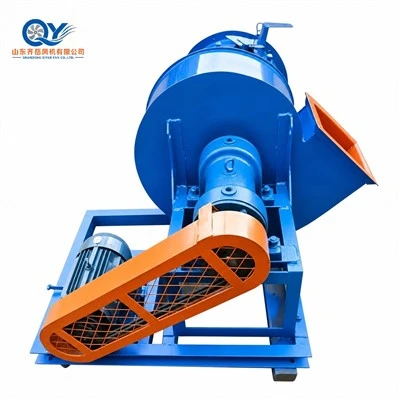
Single-Inlet Centrifugal Configuration
01
Impeller
Welded steel centrifugal impeller designed for high-pressure process-air duty.
02
Spiral Casing
Welded volute casing converts impeller velocity into useful discharge pressure.
03
Inlet
Converging inlet arrangement guides air into the impeller with reduced entry loss.
04
Drive Options
A-type direct-drive versions and C-type belt-drive versions are available across the series.
05 / Drive Arrangement
A-Type and C-Type Configurations
A Type
Direct Drive
Compact arrangement used on No.5 and No.6 configurations with direct motor-driven impeller.
C Type
Belt Drive
Separate shaft and belt transmission allow multiple operating speeds and larger fan sizes.
06 / Gas & Material Conditions
Confirm the Medium Before Selection
Clean Air
Suitable for industrial air delivery under compatible gas conditions.
Material Conveying
Confirm conveyed material type, concentration and whether solids pass through the impeller or the fan supplies clean conveying air upstream.
Corrosive Gas
Requires separate material and corrosion-resistance review.
Hot / Hazardous Gas
Temperature and explosion-protection requirements must be specified separately.
Combustible-Dust Review Before Selection
Grain and cotton dust can present fire or explosion hazards. A listed conveying application is not proof that the standard fan is suitable for combustible dust. Provide the material, particle size, solids loading and fan position in the system. Have the responsible project engineer define the dust-hazard assessment, ignition controls, required protection and acceptance documents before selecting the complete fan configuration.
OSHA combustible-dust overview is a hazard-awareness reference, not a product approval or a substitute for applicable local requirements.
07 / Selection Information
What to Send for 6-30 Selection
01 · Airflow – Required volume in m³/h or CFM.
02 · Pressure – Required static or total pressure.
03 · Application – Process air, pneumatic conveying or equipment air supply.
04 · Medium – Gas composition, dust or conveyed material.
05 · Temperature – Normal and maximum operating temperature.
06 · Drive – A-type direct drive or C-type belt drive where applicable.
07 · Electrical – Voltage, frequency, phase and quantity.
08 / Product Boundary
6-30 Is Not Y6-30
6-30
Process / Conveying Fan
High-pressure process air, pneumatic conveying and industrial forced-air systems.
Y6-30
Boiler ID Fan
Used for boiler flue-gas extraction and negative-pressure boiler draft service.
09 / Technical Resources
Related Engineering Guides
10 / FAQ
6-30 High-Pressure Fan Questions
What is the main application of the 6-30 fan?
The 6-30 series is primarily used for high-pressure process air and pneumatic conveying applications.
What sizes are available?
Published configurations include No.5A, No.6A, No.5C, No.6C, No.7C, No.8C and No.9C.
What is the reference airflow range?
The combined published series range is approximately 1,120 to 17,300 m³/h.
What pressure does the series cover?
Published reference duty points cover approximately 804 to 6,317 Pa.
What is the difference between A-type and C-type?
A-type uses a compact direct-drive arrangement. C-type uses belt transmission and supports a wider range of fan speeds and larger configurations.
Is 6-30 the same as Y6-30?
No. 6-30 is positioned for high-pressure industrial air and conveying duties, while Y6-30 is a boiler induced draft fan intended for flue-gas extraction.